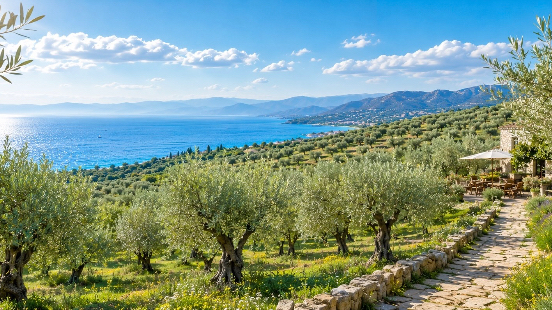
Twenty three years ago, my wite and I were having an argument about how to celebrate our first anniversary. Money was tight, and we had to choose between taking a beach vacation or buying a couch, which we did not have. Being Spanish, she cheerfully supported the beach. As a thrifty American, I argued for the couch because it was permanent. In the end, we compromised — we went to the beach.
Vacations say a lot about people. For one thing, where people choose to go indicates how much they like to be around others. In an article published in the Journal of Research in Personality, psychologists asked college students about their geographical preferences and found that shy and inward-looking people ("introverts") preferred the mountains, while outgoing and sociable people ("extroverts") preferred the ocean. The researchers found more evidence for this when they looked at who lived where: Residents of especially mountainous areas were, on average, more introverted than those who lived in flatter places. The finding is fairly intuitive. In the mountains one easily finds separation and isolation. Meanwhile, beaches tend to be crowded places full of half-dressed strangers, a potentially unappealing scene for introverts, but exactly the point for extroverts.
There's a surprising amount of research on vacations and what aspects are satisfying. To begin with, vacation planning tends to bring happiness. Data show that people actually derive most happiness from a vacation in the planning phase. On its own, this finding would seem to recommend the creation of a complex schedule, rather than a spontaneous getaway. But if complex trips bring joy in the planning, they risk giving almost no happiness in the taking. Harvard Business Review reports that people get little to no happiness boost from vacations they consider stressful. Crowded schedules and tight connections may look exciting in the process of planning, but they suggest you return no happier than when you left. Only people with simple, relaxed trips seem to get a happiness boost. Think of this as the Vacation Paradox: You have to choose between being happy beforehand or happy afterward. Sorry.
Whether people take a vacation at all says a bit about career success, but the relationship is opposite from what one might imagine. According to a study from the U.S. Travel Association, American workers in 2013 gave up 169 million days of paid time off, worth $52.4 billion. Was there a career benefit to giving up so much vacation time? There was not, according to the study. Those who left between 11 and 15 vacation days unused tended to receive smaller raises or bonuses than those who used all their vacation days. We don't know if this is because the vacation-less employees were overstressed, or because incompetent employees who couldn't get their work done skipped vacation. But the finding does indicate that vacation takers are not paying a career penalty.
Vacations also say a thing or two about one's country of origin. In America, the opening conversation topic with a stranger is frequently, "What do you do for a living?" For Europeans, the customary topic is "Where are you going on vacation this year?" Everyone has an answer, usually involving weeks and weeks at the beach or the mountains. The data provide support for the saying that Americans live to work, while Europeans work to live. The average American worker is offered just 16 days of paid holiday each year and has no legal guarantee to any time off. Compare this to Italy (31 days), Spain (34 days) and Portugal (35 days).
You might be skeptical about these statistics, noting, for instance, Spain's 23 percent unemployment rate. But having lived in Spain for years, I can assure you that calling attention to the relationship between voluntary and involuntary idleness, namely unemployment, elicits reactions that run from confusion to dismissal. So just keep it to yourself, and get back to work.
Finally, for kids, summer vacation has a surprising effect on school performance. In 1996, researchers found that the average student loses a month of academic progress during summer vacation, with the biggest impact on poor kids, who lost significantly more reading ability than those from middle-income families. Obviously there are other goals for the summer, but you have to ask whether our century-old summer vacation system is really serving students as well as it could.
• So what does your vacation say about you? Personally, I've made my peace with vacations, so we're going away this year — but we're not taking a Spanish month; just a modest American 10 days.
Lacking a consensus on whether we like people or not, we will go to both the mountains and the beach. And when we return, the kids - slightly less literate — will park themselves on the couch we finally bought.
Part 1: 語句問題(5題)
言い換え選択問題(2題)
問1.本文中の "thrifty" に最も意味が近いものを選びなさい。
(A) generous (B) economical (C) wasteful (D) reckless
問2.本文中の "skeptical" に最も意味が近いものを選びなさい。
(A) doubtful (B) confident (C) enthusiastic (D) indifferent
語形変化問題(3題)
問3.次の単語を、文脈に合う名詞形に変化させなさい。
permanent →( )
問4.次の単語を、文脈に合う名詞形に変化させなさい。
satisfy →( )
問5.次の単語に否定の接頭辞をつけて、反意語を作りなさい。
literate →( )
Part 2: 和訳(1題)
次の英文を日本語に訳しなさい。
The data provide support for the saying that Americans live to work, while Europeans work to live.
Part 3: 和文英訳(1題)
次の日本語を英語に訳しなさい。
「研究者たちは、平均的な生徒は夏休みの間に1か月分の学力の遅れを生じることを発見した。」
Part 4: 文章理解を問う問題
Which of the following best reflects the main idea of the passage?
(A) Vacation preferences and habits reveal meaningful patterns about personality, happiness, career, and culture.
(B) People who plan complex vacations always end up happier than those who take relaxed trips.
(C) Taking more vacation days consistently leads to smaller raises and bonuses at work.
(D) Summer vacation has no effect on children's academic performance.
Part 5: 英文正誤問題(1題)
次の英文が本文の内容と一致していれば○、一致していなければ×で答えなさい。
According to the passage, employees who used all of their vacation days tended to receive larger raises or bonuses than those who left many days unused.
Part 6: 英文並べ替え問題
次の語句を並べ替えて、意味の通る英文を完成させなさい。
( about / a bit / at all / career success / people / says / take / vacation / whether )
【解答】
Part 1
問1:(B) economical
問2:(A) doubtful
問3:permanence
問4:satisfaction
問5:illiterate
Part 2
「このデータは、『アメリカ人は働くために生き、ヨーロッパ人は生きるために働く』という格言を裏付けている。」
Part 3
Researchers found that the average student loses a month of academic progress during summer vacation.
Part 4
正解:(A)
【解説】
本文を構成する主要文をSVOC・品詞の両面から確認すると、論の展開が見える。
Vacations say a lot about people.
S = Vacations/V = say/O = a lot(SVO・第3文型)。この一文が全体の主題文(トピックセンテンス)として機能しており、以下の段落はすべて「休暇が人について何を語るか」という具体例(性格・幸福度・キャリア・国民性・子どもの学力)で構成されている。
Data show that people actually derive most happiness from a vacation in the planning phase.
S = Data/V = show/O = that節(SVO)。derive(動詞「〜を得る」)、happiness(名詞。happy〈形容詞〉の名詞形)。→「幸福度」という観点からの具体例。
Whether people take a vacation at all says a bit about career success.
S = Whether節(Whether people take a vacation at all)/V = says/O = a bit(SVO)。career success(名詞句)。→「キャリア」という観点からの具体例。
The data provide support for the saying that Americans live to work, while Europeans work to live.
S = The data/V = provide/O = support(SVO、for以下は前置詞句でsupportを修飾)。→「国民性」という観点からの具体例。
このように、トピックセンテンス→性格→幸福度→キャリア→国民性→子どもの学力、という具体例が並列的に展開されており、いずれも「休暇の取り方や好みが、その人についての何かを物語る」という一貫したテーマに沿っている。したがって(A)が主旨として最も適切。
Part 5
正解:○(本文では、休暇を使い切らなかった社員は、使い切った社員よりも昇給・ボーナスが小さい傾向にあったと述べられている)
Part 6
Whether people take a vacation at all says a bit about career success.